Tape at the Crown
A hatter who skips the tape because a customer "has always been a seven and an eighth" ends up stretching a hat that should have been cut right the first time.
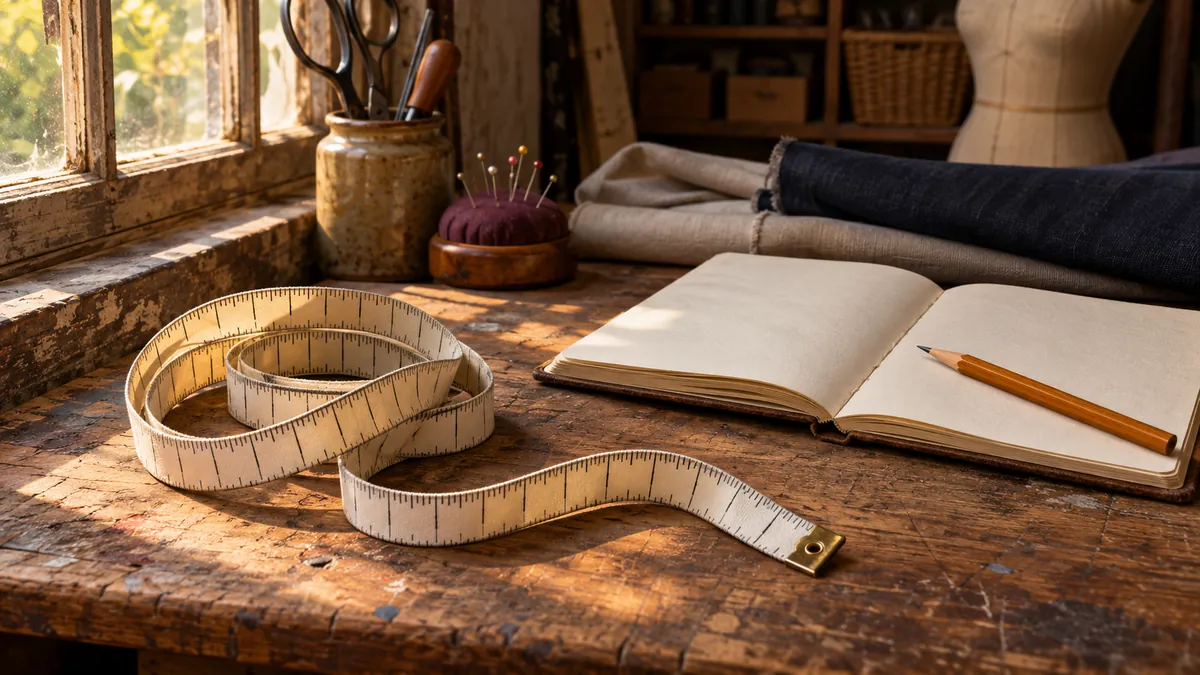
At the bench
Every fitting in our workshop begins the same way. The cloth tape goes around the head, a finger's width above the ears, across the middle of the forehead and over the bump at the back. The number is read twice and written down, with the date, in a paper notebook that sits on the corner of the bench. Only after that does anyone reach for a block or a pattern.
People are often surprised that we bother. Plenty of them have bought the same size for thirty years and assume it has never moved. But heads do change a little across the decades. Hair thins or thickens, the way a person carries weight shifts, and a band that once sat perfectly starts to ride up or leave a red line. The difference is usually a fraction of an inch, small enough to ignore and large enough to ruin a good hat.
The notebook matters as much as the tape. A number spoken out loud is gone by the afternoon. A number written next to a date can be compared with the one from two years ago, and the comparison is where the useful information lives. Without the page, the hatter would be relying on a feeling, and feelings about small changes are almost always wrong in one direction or the other.
Under the band
The habit we would stitch inside the crown for a reader in their fifties or sixties is the notebook, not the tape. Keep a small one, the kind that fits a shirt pocket, and give it one job: writing down the small things you notice about your own days, with the date beside each line.
It does not need to be a diary. A line or two is plenty. Slept poorly three nights running. Could not find the car in the lot on Tuesday. Remembered every name at the reunion. Felt sharper after the walk than before it. The point is not to worry over any single entry. The point is that the page keeps an honest record while the mind, left alone, tends to round everything off into a vague impression that things are fine or that things are slipping.
Over a month, a notebook like this shows patterns that are invisible from inside a single day. Some readers find that the foggy afternoons cluster after short nights. Others see that the forgotten errands pile up in the weeks when the calendar is crowded. That kind of observation is useful at home, and it is far more useful in a doctor's office, where "I think I have been forgetting things" carries less weight than six weeks of dated lines.
Two practical notes from the bench. First, write at the same point in the day, so the habit hangs on something you already do; ours is the end of lunch, before the afternoon cutting. Second, write things that went well too. A notebook that only records trouble becomes a list of complaints, and nobody keeps one of those for long.
A hat cut to last year's number fits badly. A week judged by last year's impression of yourself does the same. The tape and the page keep both of them honest.
A tag sewn in for the doctor
If the notebook starts to show the same kind of lapse over and over, if someone close to you has mentioned changes you had not noticed, or if a new medicine seems to have arrived at the same time as the fog, bring the pages to a physician. That is exactly what they are for, and a doctor can look at causes no hatter can.